Recent Posts

If you’ve spent an afternoon looking up how much it costs to renovate a kitchen, you’ve probably come across such a wide range of prices that it’s practically useless. One website gives one figure, the next gives a much higher one, and neither of them has actually seen your kitchen. The average cost of a kitchen refurbishment is a real statistic, but it refers to a general sample of homes, not yours, and it can’t tell you whether your project falls at the lower or upper end of that range.
That question does have an answer, and you can work out most of it for yourself before any contractor comes knocking on your door. The price of a kitchen is no mystery. It depends on a few decisions, most of which are in your hands, and understanding them is far more useful than memorising the average figure someone else gives you.
Here’s what really influences the price, based on the kitchens we build at Varoco Design & Renovation Inc. in Kitchener, Waterloo, and Guelph.
Much of the confusion surrounding kitchen prices stems from the fact that a single word covers too many things. When people say they’re renovating their kitchen, they could mean any one of these three things, and the difference between them is huge.
The simplest option leaves the room as it is and changes its appearance. Cabinet doors are refurbished or repainted, worktops are replaced, the splashback and fittings are updated, and the lighting is improved. Nothing is moved, no walls are knocked through, and no other tradespeople are involved apart from those responsible for the finishing touches. Visually, the transformation can be spectacular. Structurally, absolutely nothing has changed.
The middle-of-the-road option involves completely removing the old kitchen and building a new one in the same space. New cupboards, new worktops, new flooring, refurbished plumbing and electrical installations serving the same areas, and a fresh coat of paint. This is what most people picture when they think of a kitchen refurbishment, and it is what most projects focus on.
The most radical version transforms the room itself. A wall is knocked down, an island is installed where there wasn’t one before, the kitchen is moved to the opposite side of the room, or the space is opened up towards the dining room. As soon as the pipework is re-routed and the structure is altered, you move beyond the realm of renovation and into that of building work.
The most common mistake we see when drawing up a quote is that someone describes the third project whilst mentally calculating the cost of the first. If your inspiration photos show an open-plan kitchen island in a room that currently has a wall in the centre, no matter how carefully you look, that won’t allow you to renovate it. Knowing which of the three projects is the one you really want is the first and most important factor in determining what you’re going to pay.
If we had to sum up kitchen pricing in a single question, it would be this: does the sink stay where it is?
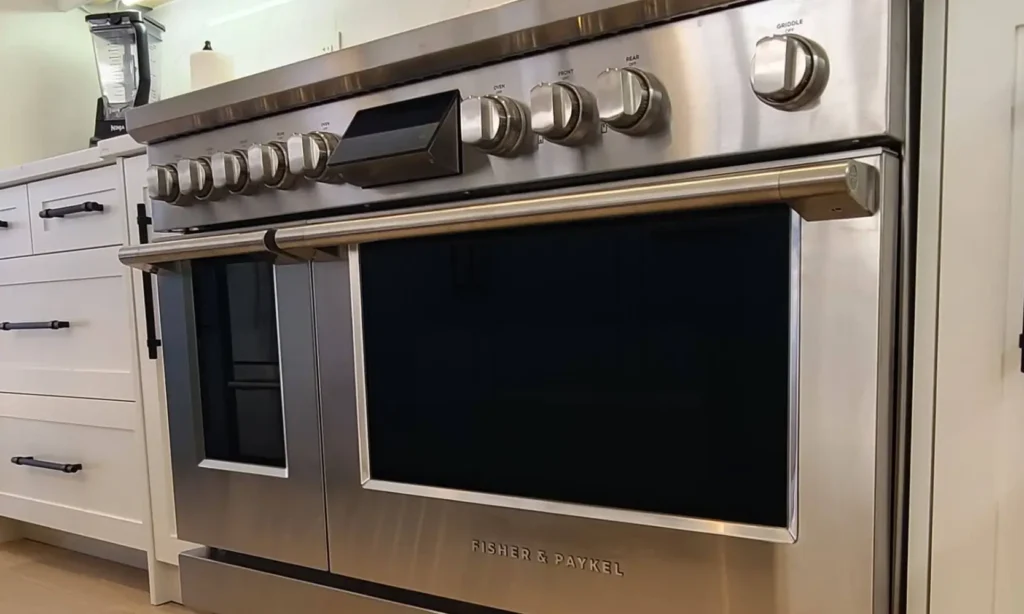
Renovating the plumbing and electrical installations in their current location is relatively inexpensive, whilst moving them is considerably more expensive. Moving a sink involves breaking up floors or walls to reroute the supply and waste pipes, which requires the involvement of qualified professionals, extends the timeframe and, in many cases, necessitates applying for a planning permission. The same applies to moving a cooker or adding an island with electricity and water connections. None of this is unreasonable or unavoidable, but it makes the difference between two quotes that, otherwise, describe kitchens of a similar appearance.
This is also the surest way to save money. A well-designed kitchen that makes the most of the available space usually works better in day-to-day use than a redesigned one, and is considerably cheaper to build. Before assuming that the layout needs changing, it is worth having a kitchen designer assess whether the problem really lies with the layout or simply with storage space.
Cupboards are the most expensive component of almost every kitchen refurbishment, which means that your choice of cupboards has a greater impact on the final budget than any other decision you make. This surprises people, as they tend to think that appliances are the most expensive part. But they rarely are.
What matters isn’t the style of the door – which is what most homeowners focus on – but what lies behind it. Cabinets can be made from chipboard, MDF or plywood, and the difference is imperceptible on the day of installation. It becomes apparent years later, when the cupboards – which bear the daily weight of crockery and kitchen utensils – either retain their shape or start to warp. A kitchen that looks identical in photographs can have a lifespan measured in decades or in years, depending entirely on that choice.
There is also the question of fit. Prefabricated cupboards come in fixed dimensions, and when those dimensions do not match your walls, the gaps are filled with filler panels. In a new-build home on a housing estate, this usually goes almost unnoticed. In an older house in Kitchener or Guelph, where walls are rarely perfectly square and ceilings are rarely perfectly level, this can mean losing useful storage space in every section and having to put up with visible imperfections in a room you’ve just paid to renovate.
As we manufacture the cupboards in our own workshop rather than sourcing them from a supplier, making them to measure according to the actual dimensions of your room is not considered an additional service for which you have to pay. If your period home has a chimney breast in a tricky spot or a large window that no standard model fits perfectly, the cupboards are made to fit the house exactly as it is.
The Waterloo region has a large number of older homes. Kitchener and Guelph, in particular, are home to neighbourhoods with houses built long before modern electrical and plumbing standards existed, and much of Waterloo’s housing stock dates from the mid-20th century. These are excellent homes. But they also harbour surprises.
Once you open up the kitchen in an older home, it’s common to discover wiring that doesn’t meet current standards, supply pipes that have reached the end of their useful life, or a structure that doesn’t quite match what’s shown on the plans. A modern kitchen places far greater demands on a home’s systems than a 1940s kitchen ever did, and adapting those systems to accommodate an induction hob and a dishwasher is often part of the project, whether planned or not.
No contractor can quote a price for something that nobody can see, and you should be wary of anyone who claims otherwise. A good quote openly acknowledges this possibility and sets out how unforeseen circumstances will be assessed and approved before any additional work is carried out. A quote that simply fails to mention the issue has not eliminated the risk. What it has done is postpone the conversation until a less opportune moment.
The practical implication for your quote is to set aside a reserve. Allocating a contingency fund for whatever might turn up behind the walls is not pessimism, especially in an older property. If it isn’t spent, you’ll have come in under budget – a welcome outcome that nobody has ever complained about.
The first is tax. Renovation quotes in Ontario are usually presented excluding the HST, which in this province stands at thirteen per cent. This is no trivial adjustment for a project of this scale, and it’s a truly unpleasant surprise to discover it after you’ve signed on the dotted line. Before comparing any two quotes, confirm in writing whether each one already includes the tax, as a quote that appears cheaper may simply be one to which the tax has not yet been added.
The second point concerns licences. Building licences are issued by local councils, so the requirements and fees are set independently by the councils of Kitchener, Waterloo and Guelph. Generally, a licence is required for work involving changes to plumbing, alterations to the electrical installation, or work affecting a load-bearing wall. Cosmetic work does not usually require a licence. Agree from the outset who is responsible for applying for the licence and whether the fee is included in the quote, as assuming that the other party has taken care of it is a common source of friction that can be avoided.
When homeowners bring us three quotes with vastly different total amounts, the explanation is almost never that one contractor is greedy and another generous. What’s happening is that the three documents describe three different projects.
One may have included the appliances, whilst another may have assumed you’ll keep your own. One may have quoted for the removal and disposal of rubble, whilst another expects that to be your responsibility. One may have specified the construction of the cupboards, whilst another has merely mentioned in vague terms that quality materials will be used. One may include the finishing touches that give the kitchen a complete look, whilst another may simply install the cupboards.
That’s why comparing total figures is virtually meaningless until you’ve compared the scope of work. Two figures are only comparable when both documents describe the same work in the same level of detail, and the effort involved in establishing this is far less than the cost of discovering the discrepancy halfway through a project.
All of the above is intended to help you think clearly about your own project, rather than to replace a proper quote. The only way to know how much your kitchen will cost is for someone to measure it, assess the condition of what’s already there, understand what you want to change, and calculate the price of the materials you’ve actually chosen.
If you’re thinking of renovating your kitchen in Kitchener, Waterloo, Guelph or Cambridge, we’d be delighted to visit your home and draw up a detailed, itemised quote that you can go through line by line and compare impartially with quotes from any other companies you’re considering. Please feel free to ask us any questions you may have; at Varoco Design & Renovation Inc., quotes are free and come with no obligation to hire us.